Christopher Caliendo
3 Essential AI Rules for Composers
Craft First. Technology Second.
·
Film Composition
·
3 Case Studies
Filmmakers: In a world where any composer can generate music with a prompt, the real question isn’t how fast you can create.
I recently explored this in a lecture built around one principle: Craft first. Technology second. To demonstrate it, I presented three behind-the-scenes case studies — each from a different creative world.
Behind the scenes · 01
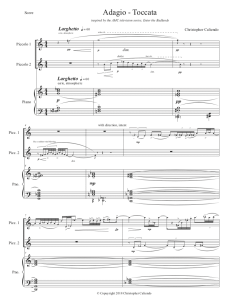
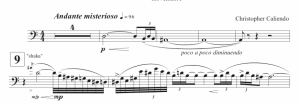
The Classical Composer’s Workshop — Star Trek Symphony, 3rd Movement
In this first demonstration, I show filmmakers how every piece begins in the traditional way: structure, counterpoint, harmonic intention, and thematic development — before any technology is introduced. Even the playback is intentionally primitive, using early sample libraries.
If the music doesn’t work before technology, it doesn’t work at all.
Only after the composition is fully formed do AI tools enter the process — assisting in refining clarity, balance, and presentation. Not the composition itself.
AI did not create the work. It clarified it.
Behind the scenes · 02
The Film Composer’s Pipeline — Wednesday / Network Placement World
The second example comes from the professional film and television pipeline, where a cue must communicate instantly to a filmmaker or music supervisor, or it gets passed over. For my Wednesday main title submission, every element was intentional:
- —Low woodwinds
- —Organs
- —Piano and bass architecture
- —Rhythmic tension built for narrative identity
The reference track was complete before any enhancement. Then AI entered the process in a very specific role:
- —Mixing refinement
- —Stereo imaging
- —Broadcast-level mastering preparation
The composition stayed unchanged. Only the delivery improved.
AI serves the deadline — not the idea.
Behind the scenes · 03
The Songwriter’s Journey — Mark Keefner & “Catch You On The Other Side”
The third example moves into the most human space: songwriting. Featuring Platinum award-winning songwriter Mark Keefner, everything begins with something no AI can generate — a lived experience.
The song starts simply: voice and guitar. No production. No enhancement. No technology. Just emotion. From there, the arrangement builds naturally — instrumentation, structure, and production decisions that serve the song’s emotional core.
Only at the final stage does AI enter for mastering and polish, with a disciplined role:
- —Clarity
- —Balance
- —Sonic enhancement — not reinterpretation
The real pattern across all three videos
Across classical composition, film scoring, and songwriting — the process is identical. A human makes the musical decision first. Then technology follows.
AI is not the composer. It is the amplifier. And it will amplify one of two things:
Final thought
AI is not here to replace composers. It is here to expose them. So the real question isn’t whether you should use it.
What are you giving it to amplify?
Caliendo made his breakthrough in Hollywood by re-scoring Sam Peckinpah’s Major Dundee for Sony Pictures — the first Hollywood composer to undertake such a task. He conducted the full soundtrack for 20th Century Fox’s The Iron House at the opening gala of the Irish Film Festival. His work has been performed by the LA Philharmonic at the Hollywood Bowl and at the Venice Film Festival.