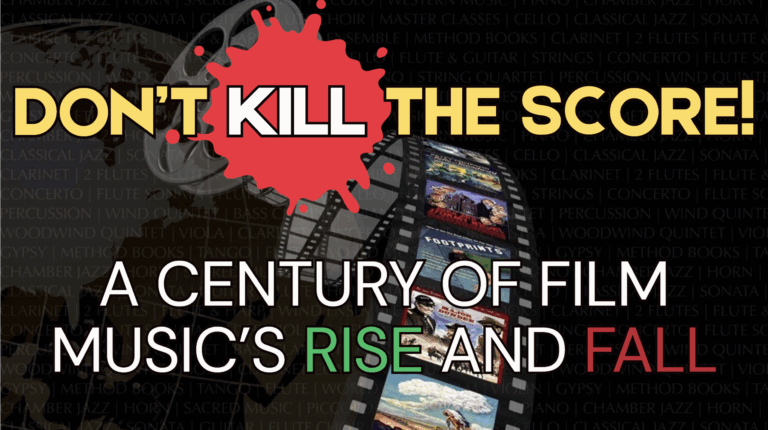
When the Composer Faded from the Frame:
A Filmmaker’s Guide to Film Music’s Decline
In the golden age of cinema, composers were storytellers in their own right. Names like John Williams, Jerry Goldsmith, and Lalo Schifrin weren’t just listed in the credits—they were embedded in the emotional memory of audiences. Think The Godfather, The Pink Panther, The Sting, or Star Trek. These themes didn’t just support the narrative; they advertised the film itself.
But something shifted. Sometime around the late 1980s and early 1990s, the role of the composer began to shrink. And by 2025, we find ourselves in a cinematic landscape where many film scores feel more like ambient wallpaper than essential narrative tools. In this edition of my Filmmaker Tips Series, we explore what happened—socially, technologically, and psychologically—to diminish the value of music in film.
A Timeline of Change: From Overtures to Oversight
1950s–1970s: Films often began with overtures and full credit sequences. Music served as a narrative prelude, setting tone and expectation. Composer names were front and center.
-
John Williams – iconic themes in Jaws, Star Wars, E.T.
-
Jerry Goldsmith – known for Planet of the Apes, Chinatown
-
Lalo Schifrin – composed Mission: Impossible theme
1970s–1980s: Directors like Orson Welles and George Lucas pushed against traditional credits. By 1977, Star Wars famously opened with only a title, relegating the full credits (and the composer) to the end.
1980s–1990s: The rise of title-only openings became standard. Composers like Brad Fiedel (Terminator) and Trevor Jones (The Last of the Mohicans) introduced hybrid orchestral-synth textures, stepping away from traditional melody.
1990s–2000s: Hans Zimmer and others brought percussive, ambient, and sample-driven scoring to blockbusters. Scores became more about visceral impact than melodic storytelling.
2000s–2025: Streaming culture, faster-paced narratives, and post-credit scenes contributed to audiences skipping musical prologues. Composer visibility dropped. Music became a sonic texture rather than a narrative voice.
-
Streaming and modern scoring trends (Soundtrack.net article)
What Drove the Shift? A Perfect Storm of Influences
-
-
Credit Culture Changes
Union requirements and studio demands lengthened credit sequences. To keep audiences engaged, studios moved them to the end. Result: composer names and musical branding lost front-line exposure.
-
Audience Behavior & Pacing Expectations
Modern viewers want to “get to the story” fast. Long musical introductions feel like a delay. This conditioned audiences to tune out music unless it’s part of immediate action.
-
Technology & Accessibility
Sample libraries, digital audio workstations, and remote collaboration made it easier to produce temp tracks. But this often replaced the unique touch of orchestral composers.
-
The Zimmer Effect
Hans Zimmer’s style—textural, percussive, emotionally direct—became the industry norm. Many studios sought similar sonic branding, pushing melody and orchestration to the background.
-
Streaming and Distraction Culture
Audiences multitask. Subtle scoring doesn’t register the same way. Without a clear melodic hook, modern music often fades into unnoticed ambiance.
-
Psychological Insights: Why Music Isn’t Valued the Same Way
Music Shapes Memory
Studies show that emotionally rich, melodic music triggers deeper memory and emotional resonance. But when scores are ambient and atonal, the brain doesn’t register them as emotionally salient.
Music Guides Visual Attention
EEG and eye-tracking studies reveal that music increases engagement with visuals. Yet, modern film scoring often focuses more on environment than narrative alignment.
Loss of Repetition = Loss of Identity
TV shows like Mission: Impossible and The Twilight Zone used repetition to embed themes. Today, few films offer musical branding. No repetition, no memory.
Composers Lost Celebrity Status
Gone are the days when a John Williams or Bernard Herrmann was part of the film’s marketing. Today, many composers work behind the scenes, with little brand visibility.
Conclusion: What Filmmakers Can Learn
If you’re a director or producer today, you have a choice. Will music be an afterthought or a storytelling partner?
Tips:
- Bring your composer on early.
- Use opening titles to brand your score.
- Choose melody when appropriate—it’s what audiences remember.
- Educate your audience by featuring composer interviews or soundtrack featurettes.
Reclaiming the value of music means restoring the composer to their rightful place: not just in the credits, but in the heart of the story.
Christopher Caliendo is an award-winning composer and film scoring historian, honored with the Henry Mancini Award for Film Scoring. He began his television career at CBS under Jerrold Immel, scoring for Dallas, Knott’s Landing, and Paradise. His work spans collaborations with Emmy-winning teams at Fisher-Merlis Television, Cartoon Network, Warner TV, and Discovery. As a guest speaker at film schools, Christopher shares insights on bridging the creative gap between directors and composers, preserving the history of film music, and strategies for crafting scores that are both artistically compelling and budget-conscious.
📧 info@christophercaliendo.com
🌐 www.christophercaliendo.com